
Artists
Andrea Branzi
Andrea Branzi, Voliere
Trésor-en-valise
Solo exhibition / 21.3-23.5 2026
in collaboration with Galleria Luisa delle Piane
curated by Emanuela Nobile Mino
The latest phase of an ongoing collaboration between Galleria Antonella Villanova in Florence and Milan-based Galleria Luisa Delle Piane, this time the project is a poetic tribute to one of the most eminent and prophetic figures in Italian design, the Florentine architect and designer Andrea Branzi (Florence 1938 - Milan 2023). Branzi is the subject of the major monographic exhibition Andrea Branzi by Toyo Ito. Continuous Present, on view from March 19th at the Triennale di Milano in collaboration with Fondation Cartier pour l’art contemporain.
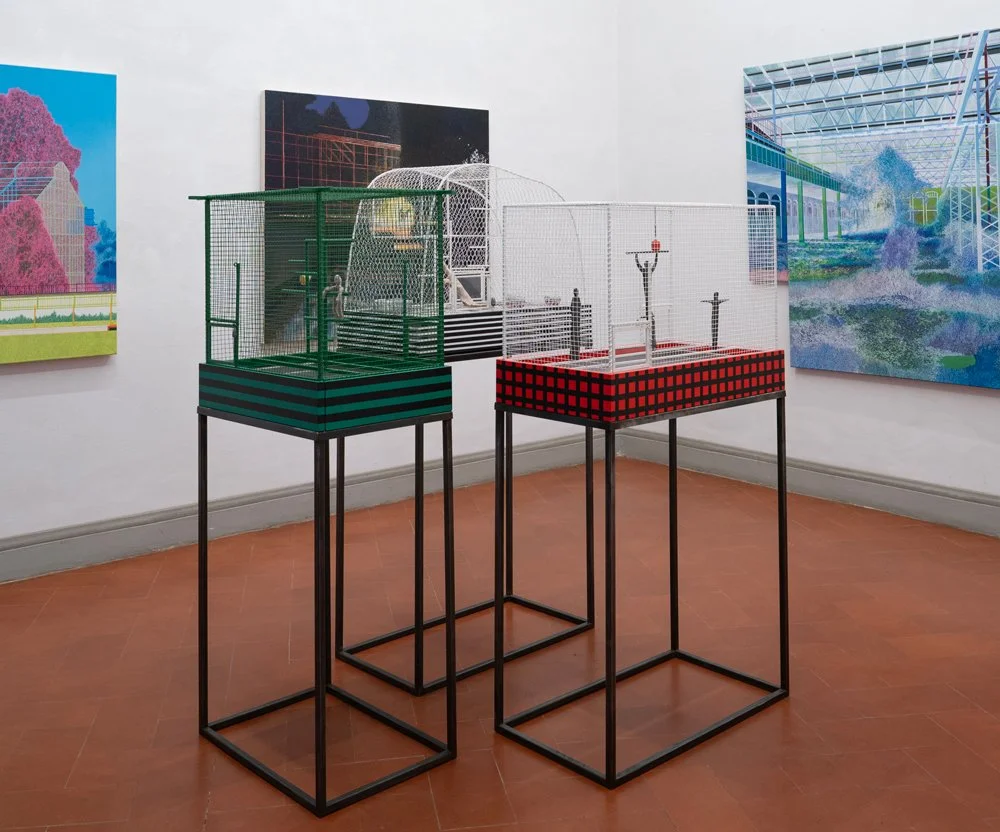
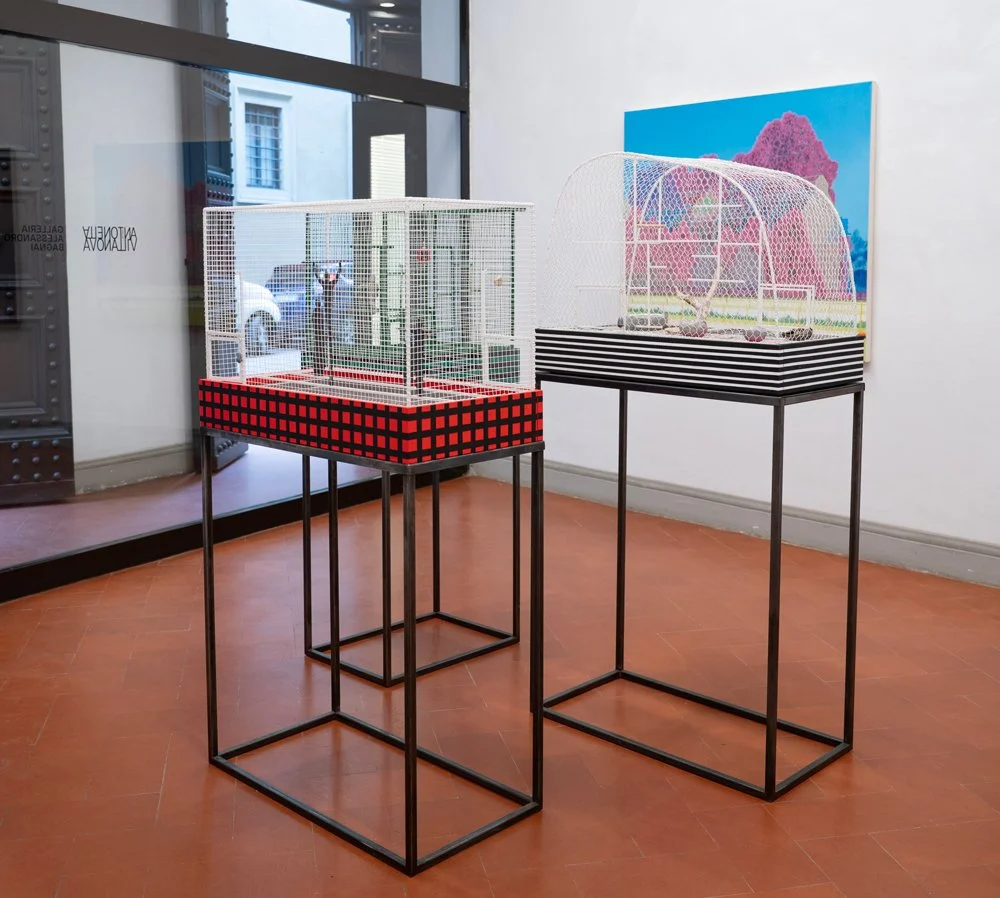
In the Florence exhibition, three works are on show from the Voliere collection created by Andrea Branzi in 2016 for Galleria Luisa Delle Piane, with which the author had a fruitful alliance for several years.
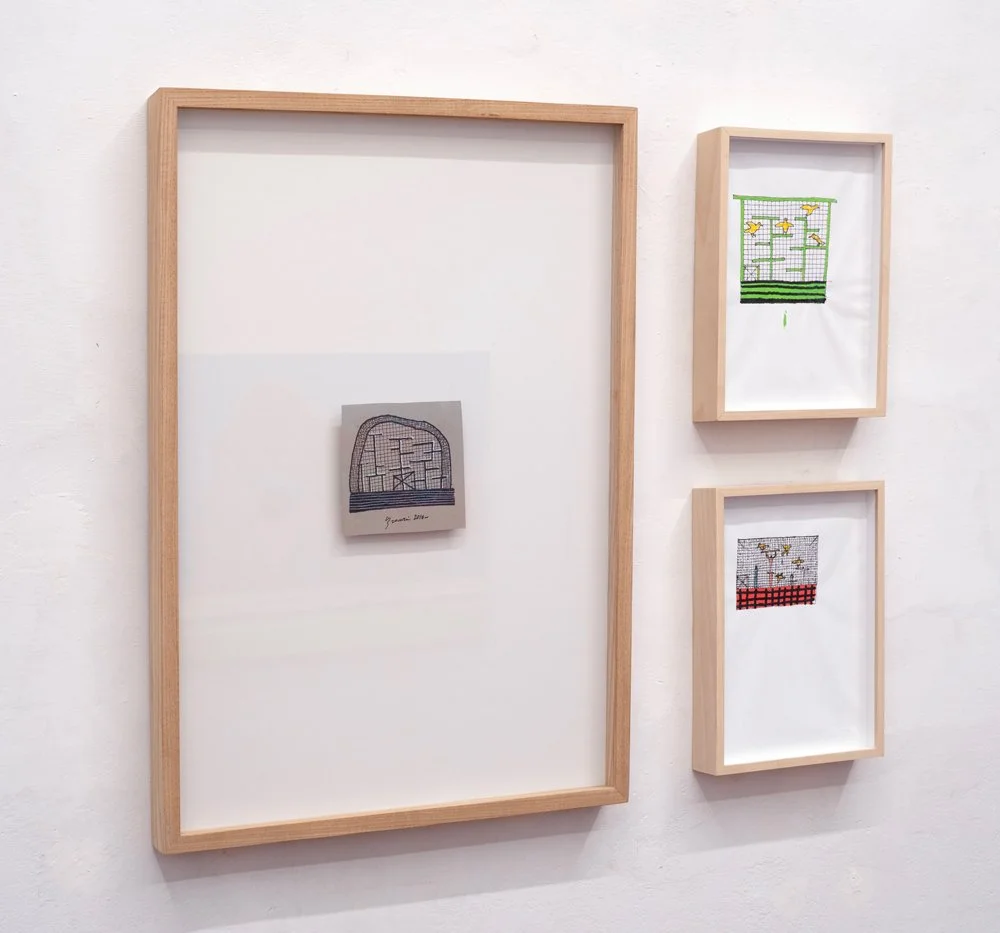
The Voliere (Birdcages), made of metal mesh, wood and decorative iron elements, are miniature architectural structures, micro-places designed as self-sufficient little domestic spaces, potentially functional and at the same time purely sculptural.
In Branzi’s holistic approach to design, architecture and urban design, which fully came into its own in later years, animals often played a central role. For example, Animal City (2008-2023), a collaborative effort developed with Stefano Boeri for the Grand Paris project and restaged in 2025 as a temporary exhibition in the Palais Royal-Musée du Louvre metro station to mark the opening of the new Fondation Cartier headquarters, was based on a “non-anthropocentric urban ethic.” It envisioned animals roaming free around the French capital, and espoused the idea of a more organic, egalitarian symbiosis between humans, the city and nature.
Branzi had already begun to imagine a sort of return to a neo-primitive condition in the early 1980s, at the height of the postmodern period, with Animali domestici, a collaboration with his wife Nicoletta Morozzi consisting of a series of clothes and hybrid furniture pieces that juxtaposed industrial materials and manufacturing techniques with archetypal natural forms and materials like hazelnut and birch branches. The aim was to improve the landscape of domestic living spaces, as well as the relationship between people and the objects they surround themselves with.
In Mediterranean tradition since antiquity, domestic animals have been considered protective, talismanic creatures. Branzi saw them as “magical presences possessed by indecipherable divinities” and endowed with a soul or anima, a term with a Latin and Greek root (ànemos/breath of life). Drawing on idioms of architectural language, Branzi’s Voliere are not cages that imprison, but rather structures that free the gaze, opening the mind to rethink rituals of private space and the relationshipbetween man and the natural realm. “When you introduce a fragment of nature into a design, it releases an expressive force infinitely superior to the entire geometric system of modernity, while its uniqueness makes it an almost sacred presence” (Andrea Branzi, Domus, May 2018).
Displayed in the gallery’s first room, Voliere engage with young Genoese artist Miriam Marafioti’s urban landscapes on structural and functional levels, as the viewer’s gaze moves from his self- contained microcosms designed as ideal dwellings for domestic “spirits” to her macrocosms of architectural “cages” conceived for residents of modern, fragmented metropolises.
ANDREA BRANZI
Andrea Branzi (Nov. 30, 1938 – Oct. 9, 2023) architect, designer and theorist, was born in Florence, where he earned a bachelor’s degree in 1966; he lived and worked in Milan from 1973 on. He was a leading exponent of the Radical movement and of new Italian design, and made his mark in that period by analyzing contemporary life through the lens of design anthropology. From 1964 to 1974 he was a part of Archizoom Associati, the first avant-garde group to make a name for itself on an international level; their designs are now conserved at the Center for Communications Studies and Archive of the University of Parma. His graduate thesis and numerous designs are at the Centre Georges Pompidou in Paris, which inaugurated a permanent room dedicated to his work in September, 2017. He was a co-founder of Domus Academy, the first international post-graduate school of design. The author of numerous books on the history and theory of design, he curated various exhibition on related topics in Italy and abroad. In 2018 the Royal Academy of Fine Arts of Stockholm awarded him the Rolf Schock prize for Visual Arts. In 1994 he was honored with the Compasso d’Oro Career Award. In 2008, the faculty of the “Ludovico Quaroni” Architecture Department of the Università La Sapienza in Rome awarded him an Honorary Degree in “Industrial Design”.
*Trésor-en-valise is an itinerant exhibition format curated by Emanuela Nobile Mino that consists of periodic events dedicated to experimentation in contemporary art, design and jewelry, involving Italian and international galleries within a framework of mutual cooperation and hospitality, offering a vehicle for small groups of work to move from city to city and be shown in ever-changing contexts to a broad audience.